My Portfolio
CRLP Tool 1 – CDC Member Data Analysis
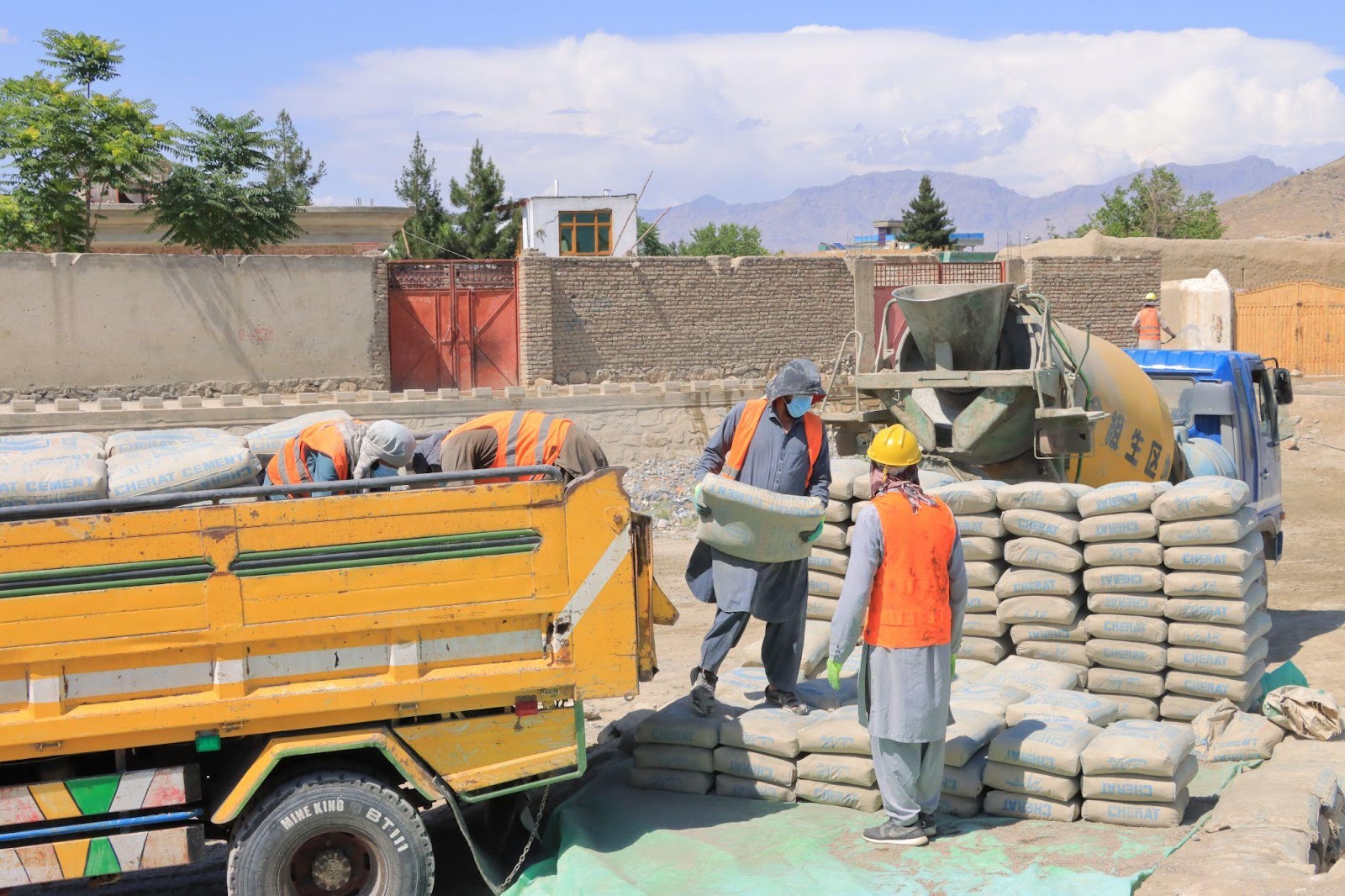
This analysis was conducted as part of the UNIOPS Afghanistan Community Resilience and Livelihoods Project (CRLP) to support verification and profiling of Community Development Council (CDC) members using Tool 1. The primary purpose of the analysis is to assess the Completeness, consistency, and reliability of CDC members data collected during field verification exercises, and to identify updated, replaced, or missing members, including the availability of contact information. The findings aim to inform program monitoring, reporting, and decision making by providing a clear and evidence-based overview of CDC membership status across sampled communities. A total of 1,787 CDC members interviews were conducted across 236 Community Development Councils (CDCs) as part of the CRLP Tool 1 verification process. • The dataset demonstrates broad geographic coverage, with data collected from 21 provinces, representing approximately 62% of CDCs in Afghanistan. • CDC membership shows a near-balanced gender distribution, comprising 962 male (54%) and 825 female (46%) respondents. • The largest concentration of sampled CDCs was observed in Nimroz (12%), Baghlan (11%), and Kapisa (8%), reflecting areas with higher program coverage.
View Project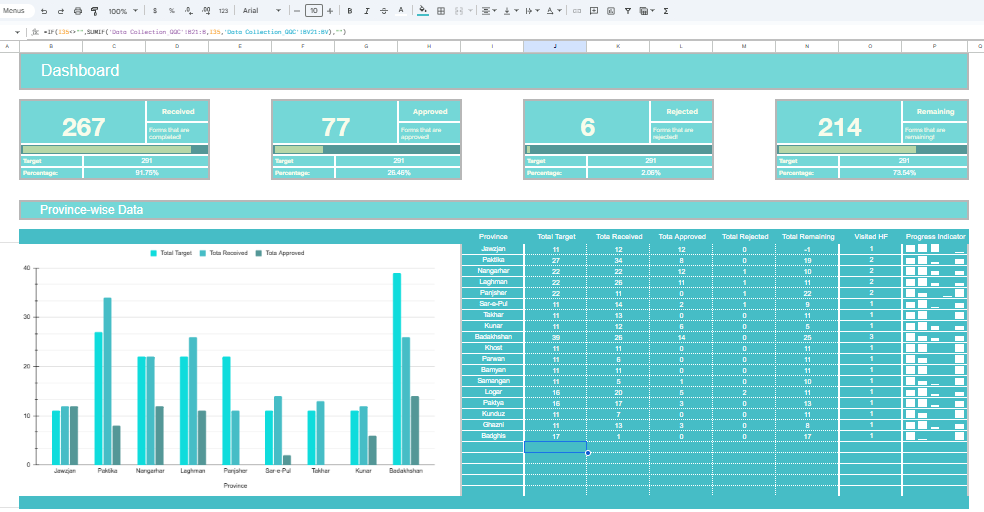
HER2 ESS — Data Collection Tracker & Monitoring Dashboard
This project is a professionally designed Google Sheets–based data collection and monitoring system developed to manage large-scale field operations across multiple provinces. It supports the full lifecycle of data collection, from planning and field execution to quality assurance and reporting. The system integrates structured data entry, automated validation checks, and dynamic dashboards to ensure accurate tracking of progress, improve data reliability, and enable real-time decision-making for program stakeholders.
View Project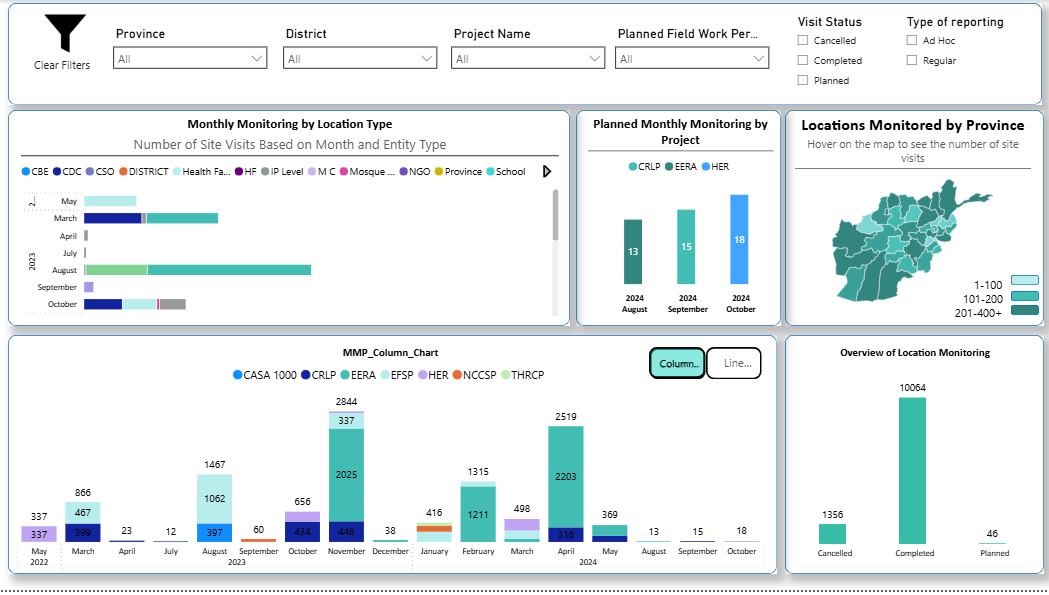
Climate Change: Earth Surface Temperature Data Analysis
This project is a professional Power BI dashboard designed to monitor and analyze site visit activities across multiple projects and provinces. It centralizes data on planned, completed, and cancelled visits into a single interactive reporting environment. The dashboard enables users to filter data dynamically by province, district, project, visit status, reporting type, and time period. It provides clear visibility into operational performance and field monitoring efficiency. Data is cleaned and transformed using Power Query to ensure consistency and reliability. A structured data model supports relationships between projects, locations, and monitoring activities. DAX measures are used to calculate key metrics such as completion rates and monthly trends. The dashboard includes geographic mapping and time-based analysis for deeper insights. Gender-disaggregated visuals enhance reporting by highlighting inclusivity and representation. Overall, the solution supports data-driven decision-making, improves transparency, and strengthens program monitoring.
View Project
Banking Credit Risk & Customer Behavior Analysis
This project is an end-to-end analytical solution focused on assessing customer credit risk and detecting fraudulent transaction behavior within a financial context. It integrates two complementary datasets: the UCI Credit Card Default dataset for customer-level risk analysis and the European Credit Card Transactions dataset for fraud detection. A structured SQL-based data architecture was designed to transform raw data into clean, analysis-ready datasets through a staging and core layer approach, ensuring data integrity, reproducibility, and auditability. The analysis focuses on understanding customer repayment behavior, credit utilization patterns, and transaction-level anomalies to identify high-risk segments and potential loss exposures. Advanced data validation, deduplication, and feature standardization techniques were applied to ensure high data quality. The project enables financial institutions to make data-driven decisions by translating raw financial data into meaningful insights, supporting improved credit approval strategies, risk segmentation, and fraud monitoring.
View Project
Hospital Readmissions Analysis
In this project a ten-year hospital inpatient dataset is analyzed to evaluate whether diabetes-related factors are associated with hospital readmission. The dataset supports the assessment of clinical utilization patterns, diabetes management indicators, and patient-level characteristics to determine potential predictors of readmission outcomes within a healthcare context. The objective of this project is to transform raw hospital records into a structured, analysis-ready dataset that enables evaluation of diabetes as a contributing factor to readmission risk and supports business intelligence reporting for healthcare decision-making.
View Project